-
Science and research
- ⋅
- 02/09/2026
- ⋅
- Reading time approx. 2 min
Wpływ wysokiego ciśnienia na temperaturę topnienia materii twardej i miękkiej
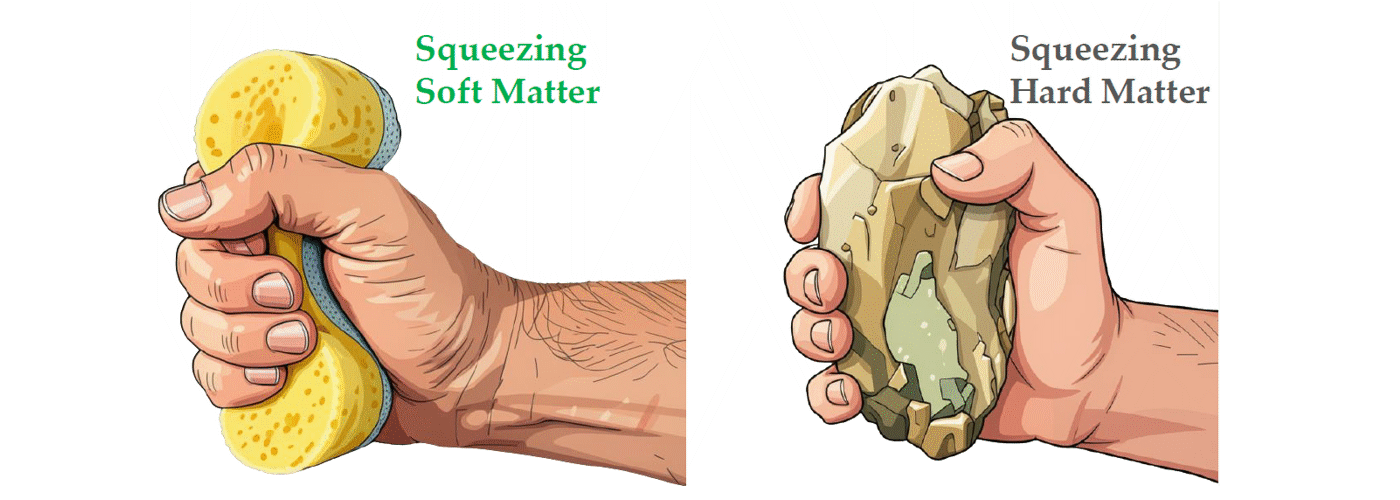
Melting, i.e., the discontinuous phase transition between liquid and solid, is one of the most important phenomena in physical chemistry, Earth sciences, and materials engineering. It also shapes a variety of natural processes, from deep-Earth geophysics to the melting of glaciers and large ice sheets. Melting also underpins numerous technological applications, from metallurgy and the chemical industry to pharmacy and food technology, and particularly high-pressure preservation.
The Open Access publication has just been released: A. Drozd-Rzoska, S.J. Rzoska, I. Grzegory, S. Porowski, Melting Temperature under Pressure in ‘Hard’ and Soft Matter, International Journal of Molecular Sciences, 27, 756 (2026); https://doi.org/10.3390/ijms27... (IF = 6.3, 140 pkt MNiSW)
The publication addresses the fundamental problem of melting point (Tm) changes under high pressure (P). The report focuses on the relevant topical cognitive aspects, filling significant knowledge gaps by presenting:
- The importance of intermolecular interactions: A coherent discussion on Tm(P) behavior for both ‘Hard Matter’ (‘standard matter’/solid state) and Soft Matter systems.
- The role of the negative-pressure domain: A novel model picture linking different types of temperature behaviors dTm/dP > 0), dTm/dP < 0\), and the Tm/P curve maximum), which also shows the non-obvious relevance of the negative-pressure domain (stretching of matter) to the melting point.
- Universal scaling: The ultimate validation test of the recent ‘universal’ parabolic scaling of Pm(T) against empirical data.
The study highlights a significant distinction between how different classes of materials respond to compression:
- Hard Matter: The empirical evidence focuses on systems highly relevant to the semiconductor industry: silicon (Si), germanium (Ge), and gallium nitride (GaN).
- Soft Matter: These include unique polymeric systems and the liquid crystalline pentylcyanobiphenyl (5CB), in which a symmetry-selected melting/freezing process takes place.
- Hybrid Case: The report concludes with an analysis of graphite and diamond—exceptional cases combining features of both categories.
A key aspect of the work is addressing the long-standing methodological challenge in soft matter sytems related to impurities. The innovative experimental solution presented in this paper effectively eliminates this issue, opening the door to remarkably precise measurements. More details can be found in the original paper.
Latest