-
Science and research
- ⋅
- 19/11/2026
- ⋅
- Reading time approx. 2 min
Pelletization pressure as a parameter for tuning superconductivity in fluorine-doped PrFeAs(O,F)
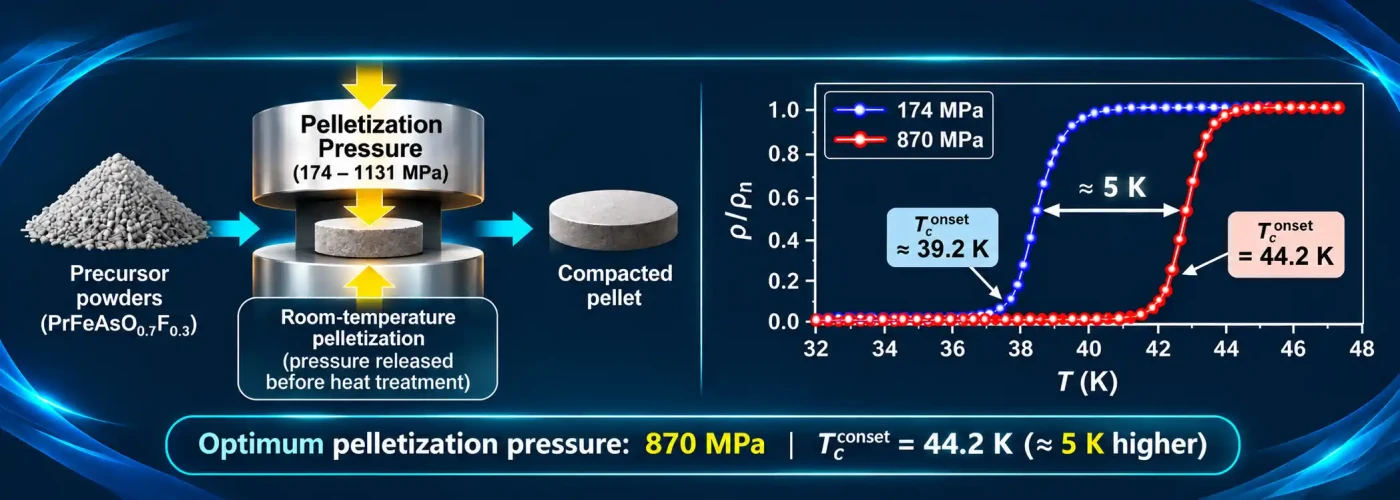
Iron-based superconductors are commonly prepared using a conventional synthesis process at ambient pressure, in which precursor powders are mixed, compacted into pellets and subsequently heat-treated to form the superconducting phase. In some approaches, high-pressure synthesis techniques are also employed, with pressure maintained during heat treatment to promote phase formation and influence the final properties of the material.
In the conventional approach, a question arises: can pressure applied only during pellet forming (before annealing) affect the final superconducting properties of the material? What is the effect of the pressure magnitude, which determines the degree of initial densification of the powder? The new study addresses these questions by examining iron-based superconducting materials pressed at room temperature under different pressures before synthesis. It investigates how changes in powder packing, particle contacts, and pore structure affect the structure, microstructure, and superconducting properties of the resulting material.
Prof. Shiv Singh's research group at the Laboratory of Superconductors and Hydrogen Technologies (NL-6) our institute has systematically investigated this approach for the first time in an iron-based high-temperature superconductor, fluorine-doped PrFeAs(O,F). By varying the pelletization pressure from 174 to 1131 MPa, the team revealed a strong dependence of the superconducting response on the initial compaction conditions. Importantly, the applied pressure was completely released before the subsequent heat-treatment procedure. Among the investigated samples, the one pelletized at 870 MPa exhibited the most favourable overall superconducting properties, achieving an onset transition temperature of 44.2 K – approximately 5 K higher than that of the lowest-pressure sample. It also showed a narrower superconducting transition, the highest relative density and favourable effective magnetic critical-current density at high magnetic fields. These improvements reflect the combined influence of fluorine incorporation, crystal structure, phase composition, porosity and grain connectivity, together with changes in vortex dynamics.
The findings reveal that the influence of pressure can extend beyond the pelletization process itself, offering an additional route to tailor superconducting properties in iron-based materials. The study provides new insight into how initial pelletization conditions influence the relationship between material structure, composition and the final superconducting performance.
More details can be found in the publication:
Jayant Kumar, Konrad Kwatek, Tatiana Zajarniuk, Taras Palasyuk, Yaroslaw Konopelnyk, Tomasz Cetner, Cezariusz Jastrzębski, and Shiv J. Singh, “Pelletization pressure engineering of the superconducting properties of fluorine-doped PrFeAsO”, Journal of Alloys and Compounds 1087, 192424 (2026) (Impact Factor: 6.7). https://authors.elsevier.com/a...
*The Open Access is available for 50 days from the publication date.
Latest