-
Science and research
- ⋅
- 25/06/2026
- ⋅
- Reading time approx. 2 min
Wiemy więcej o ruchu dyslokacji o dużych wektorach Burgersa w materiałach InGaN/GaN
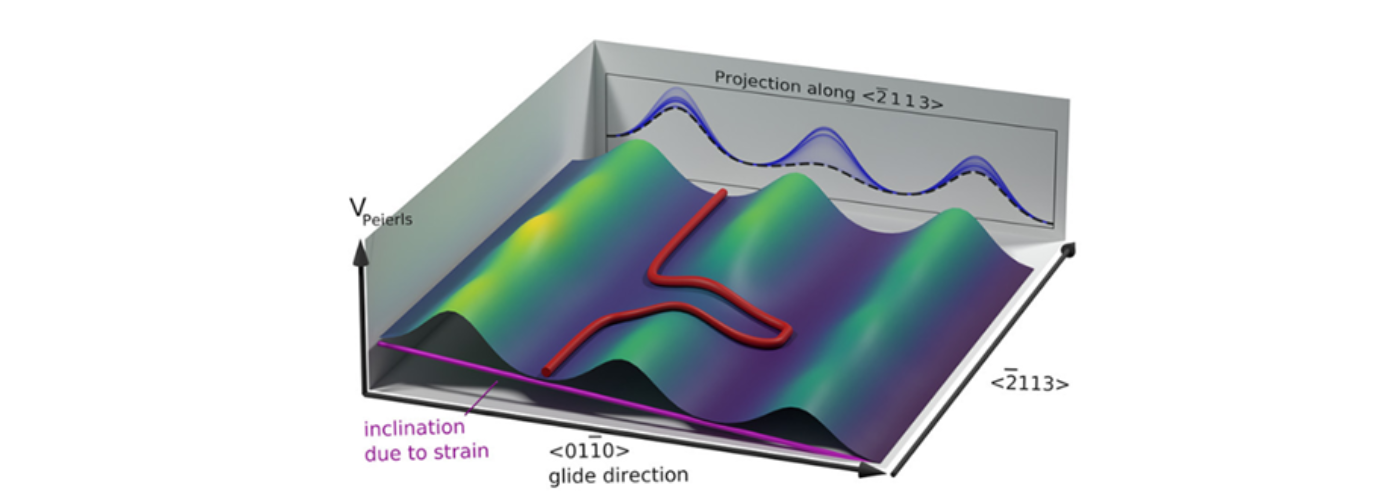
What happens in the microstructure of a material when it undergoes plastic deformation? How do dislocations move? Scientists have been trying to understand these processes for nearly 100 years and are still discovering interesting aspects, especially when the deformation involves materials with very strong covalent bonds, where some dislocations have particularly large Burgers vectors, such as gallium nitride (GaN).
Thanks to advanced X-ray imaging using synchrotron radiation it was possible to observe the real-time motion of individual dislocations in InGaN/GaN semiconductor structures. The analysis of the dislocation activity is described in the recently published paper Robert Kernke, Carsten Richter, Joanna Moneta, Tobias Schulli, Grzegorz Muziol , Calliope Bazioti, Martin Albrecht, Julita Smalc-Koziorowska and Tobias Schulz, “Stop-and-go dislocation dynamics in semiconductor heterostructures revealed by in-situ X-ray imaging” in Acta Materialia. https://doi.org/ 10.1016/j.actamat.2026.122446
The study revealed that dislocations with large Burgers vectors in InGaN/GaN material system, rather than moving continuously, travel in discontinuous intervals characterized by stops-and-go behavior, and their activity gradually weakens at a constant temperature. Statistical analysis of hundreds of propagation events allowed for the formulation of a stochastic model of a jump process, in which dislocation segments either become stationary or overcome a heterogeneous sequence of energy barriers resulting from changes in the dislocation core caused by slip.
The published research was carried out within the Polish-German OPUS LAP project “In-situ studies of plastic relaxation in InGaN buffer layers to increase the indium content limits in nitride epitaxial layers” which is partly realized at the Institute of High Pressure PAS. Co-authors of the article are three scientists from the Institute: Joanna Moneta, Grzegorz Muzioł, and Julita Smalc-Koziorowska.
We recommend to find out more about this research: https://doi.org/https://doi.or....